BioTech + Art
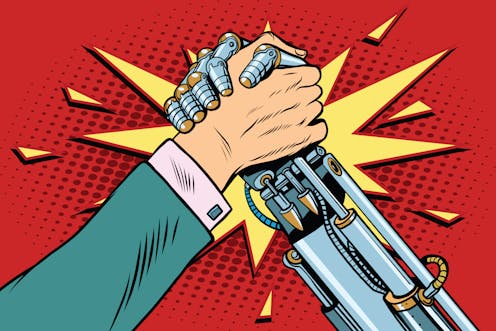
BioArt acts as a perfect combination of practical and expressive. Not only does BioArt with Technology serve as logical technology that has the ability to improve human life, but it also offers a visual for intertwining two completely different areas of life to become one successful unit. Specifically, when I think of BioArt, I am actually reminded of Week 1 - Two Cultures. During Week 1, C.P. Snow discusses the distinction between science and humanities. Many questions arouse around whether these two distinctly different arenas could coexist, and if so, to what extent? How?
 |
| Science and Humanities Collaborating |
So, later in this class, the Chapter of BioTech + Art become the topic of the week. This reminded me of a very prominent form of BioTech in our culture today: prosthetics. So, it became evident to me that further down the road - after schooling has concluded - people were suddenly able to intertwine the two very different cultures of science and humanities in order to create a product that assists individuals in living a more successful and peaceful lifestyle.
 |
| Stelarc & the implanting of an ear |
Furthermore, there are other areas of life that this cohabitation of different lifestyles have become prominent. Maybe perhaps in museums or art exhibits. However, when I was researching BioArt, I came across someone by the name of Stelarc. This man craves much human attention, and has pierced his body in unimaginable ways to simply raise eyebrows. But, for his next 'stunt' to exhibit his BioArt 'side,' he decided to surgically implant an ear onto his forearm. Stelarc discusses how he did not implant this 'ear' on his arm to improve his own personal hearing. But, with this surgical placement of another ear, other people from all over the world that are connected to this microphone are actually able to hear and interpret the sounds occurring around Stelarc at all times. Although this is an extreme case of BioArt, it IS indeed an example of BioArt. This person, although very weird, demonstrates the cross and cohabitation of these two unlike cultures of Bioscience and art.
 |
| World Working Together |
References
CommForum. “Ultimate Truths: Comparing Science and the Humanities.” The Communications
Forum at the Massachusetts Institute of Technology, The Communications Forum at the
Massachusetts Institute of Technology, 2 Sept. 2016.
Feedstuffs. “Globalization Having Little Effect on Food Choices.” IGCAT, 11 Apr. 2017.
Haridy, Rich. “Art in the Age of Ones and Zeros: BioArt.” New Atlas - New Technology & Science
News, New Atlas, 17 Mar. 2017.
News, New Atlas, 17 Mar. 2017.
Villariba, Mannet. “The Body Is Obsolete - Stelarc.” YouTube, YouTube, 10 Jan. 2013.
Willis, Martin, et al. “Humanities and Science Collaboration Isn't Well Understood, but Letting off
STEAM Is Not the Answer.” The Conversation, 19 Sept. 2018
STEAM Is Not the Answer.” The Conversation, 19 Sept. 2018

Hi! Bella,
ReplyDeleteI really like your blog! I wrote on the same ear implant topic in my blog, and I totally agreed with your analysis that this case shows the extreme cohabitation of biotechnology and arts. I also think this type of bio art can have significant functions in our world to actually solve problems of the disability.
Bella, I love that you brought up prosthetics as an art form. I have taken a few classes on disabilities studies and there have been complaints from their community about people cutting off or modifying limbs to use prosthetics, all in the name of art. I think it contrasts the typical debate over ethical concerns - this topic raises moral concerns and can be seen as infringing on the concept of disabled.
ReplyDeleteHello Bella,
ReplyDeleteI really loved how you connected this topic to Week 1, the foundation of this class and this topic. I never really considered prosthetics as a type of bioart until you mentioned it in your post. I thought your take on how the world views artists collaborating with scientists in creating these wonderfully weird pieces really just depends on each individual's perspective, rather than society as a whole. Great analysis!
Best,
Sebastian Haworth
Hi Bella,
ReplyDeleteI really like how you brought up the topic of week one. This topic totally connects to C.P. Snows ideas discussing the distinction between science and humanities. I think with bio-art the line between what is moral and what is not gets hazy. And I agree with you when you say there are many questions around whether these two distinctly different arenas could coexist.
Hi!
ReplyDeleteYour blog post was interesting as you connected Week 1's topic into Week 6's. I found Stelarc very disturbing and unusual, causing me to be confused by his work. I like how you further supported the notion that major divisions in society can come together in several different ways!
Hi Bella!
ReplyDeleteI really thought that your blog was interesting. Other students mentioned how you brought in week one with your discussion of biotech and art as there is the strong connection with the two cultures idea of CP Snow. I think you did a really great job of understanding and using examples from this week's lectures.